I came home and sat down at the computer. I opened an email from Borya Goloborodko and… I felt ill. Just a few words and two terrible ones:
– Khash has died…
Yura Khashchevatsky was a friend of my youth, my maturity and, yes, my old age! In short, a friend for life. Tremendous talent, kindness, courage, and bravery — all of this was Yurka. A master. I think that in documentary cinema he received more international and national awards than all his fellow countrymen and colleagues. But most importantly, most importantly — he was a dear and long-awaited friend…
I am sitting here, overcome by such sadness that I could howl, but I have to, I have to take the text I wrote for my memoirs, read it again, add to it, and give it to those who will read it, remember him, or simply learn that such a person once lived.
KHASH, KHASHIK, KHASHENKA
In the early 1960s, we had no idea about bards or singer-songwriters. We knew Bulat Okudzhava’s songs and poems, Vysotsky’s songs… Yurka Khashchevatsky stood in for everyone else. He knew an enormous number of songs and sang, sang for us. Much later, we learned that the lyrics had been written by Brodsky and Vizbor, Gorodnitsky and Klyachkin, Kim and Kukin. Oh, Yura had good taste!
May I not be destined to die far from you,
in the dove-blue mountains,
echoing the crooked-legged boy.
May you not be destined,
hurrying the clouds,
to see in the darkness
my tears and miserable grief.
Yurka did not know what came next, but it was wonderful, simply wonderful! And many years later I read “Stanzas to the City”… It was like meeting a dear person after a long separation…
He also sang our songs. My “Wolf Cubs,” his own “Queen of Spades” and “On the Georgian Military Road,” and, of course, the wonderful song by Yura Makarov, Valya Krapiva, and Yura Volovich, “Remember, Vasya…”. No, this sounds too dry. I have to quote at least a little.
“Wolf cubs do not always grow into wolves,
And lion cubs do not always grow into lions.
How many Little Princes have vanished for nothing,
How many old scoundrels have remained alive…” — this one is mine.
“Well, it happens to everyone, and every year,
For we are neither saints nor even gods.
There is a turn ahead, and a turn behind,
Just like on the Georgian Military Road…” — this one was Yurka’s.
“Remember, Vasya, what times those were,
Remember, Fedya, there was a revolution.
First we crushed all the Jews,
Then we took out the tsar with the ‘Aurora’.
Now we can see that we fought not in vain,
But for Soviet power…!” — this one belonged to the two Yuras and Valya.
Our fairly large group would gather either at Yurka’s place or at the Palace of Students. We would have a little to drink, talk and, of course, sing. We often held competitions — there were many people in the group who wrote poetry. A topic was chosen, texts were written, and Yurka would choose the best one, in his opinion, set it to music, and perform the finished song. The songs were what people today would call risky. Once, I even got into trouble because of them. I started getting failing grades during my exams. It was obvious that the teachers felt sorry for me: they did not enter the grades in the register. Instead, looking away, they simply sent me back to “study some more.” The “Invincible and Legendary” was already very, very close. One day, our institute’s “little organist” approached me (a “small employee of the big organs,” as Khash called him) and took me aside. Then, pulling out a tape recorder, he played my songs for me. I stood there stunned.
– Do you understand everything? — the organist asked.
– Everything… — I whispered.
– And you won’t do it anymore?
– I won’t… — I said, to my shame.
– All right, go and take your exams!
I went and passed them. But Yurka did not get off so easily. He staged a play based on Ludvik Ashkenazy’s book “The Black Box” for a competition evening. It was the winter of 1968. The Prague Spring had not yet ended. Our tanks were still in Prague. Ashkenazy had left Czechoslovakia and was broadcasting on Radio Liberty… Even then, Yurka showed us an example of integrity and courage.
Yura was expelled from the institute. Though a year later, he was reinstated…
He was talented… I remember that shortly before this, the Leningrad Lenkom Theatre came to the city with the production “Visible Song.” Well, we wanted to give it a try ourselves. Yura conceived and staged “Robinson,” based on Felix Krivin, and “Grenada,” based on Mikhail Svetlov. Robinson was frightening, highly unexpected and… remarkably convincing. And “Grenada”… It was a story about a black-market dealer who made a living trading imported goods. Unexpected? Everything with Yurka was unexpected.
He wanted to become a director, and he did. A play, a feature film, success. But Yura decided: “Not that!” — and turned to documentary filmmaking. And once again, success — tremendous success. I will list only the awards for the film “An Ordinary President.”
- Sakharov Prize of the Russian Writers’ Union “April” (Moscow, 1997)
- “Cinema for Peace Award” at the Berlin International Film Festival (Forum), 1997
- Grand Prix, Human Rights Watch (New York, 1998)
- “Golden Gate Award” (San Francisco, 1998)
Lukashenko’s “boys” broke into Yurka’s workshop and smashed his legs with crowbars. And he… continued working.
In total, I counted more than a dozen prestigious awards for documentary filmmaking. The film “An Ordinary President” is known throughout the world. His film “In Search of the Yiddish Language,” created at the request of Alexander Gorodnitsky, is also widely known.
Yura gave me the title for my most successful, and first, parable, “Shlomo and the Generalissimo.” He knew how to inspire admiration and how to give.
God! Why, why am I writing about him in the past tense!?
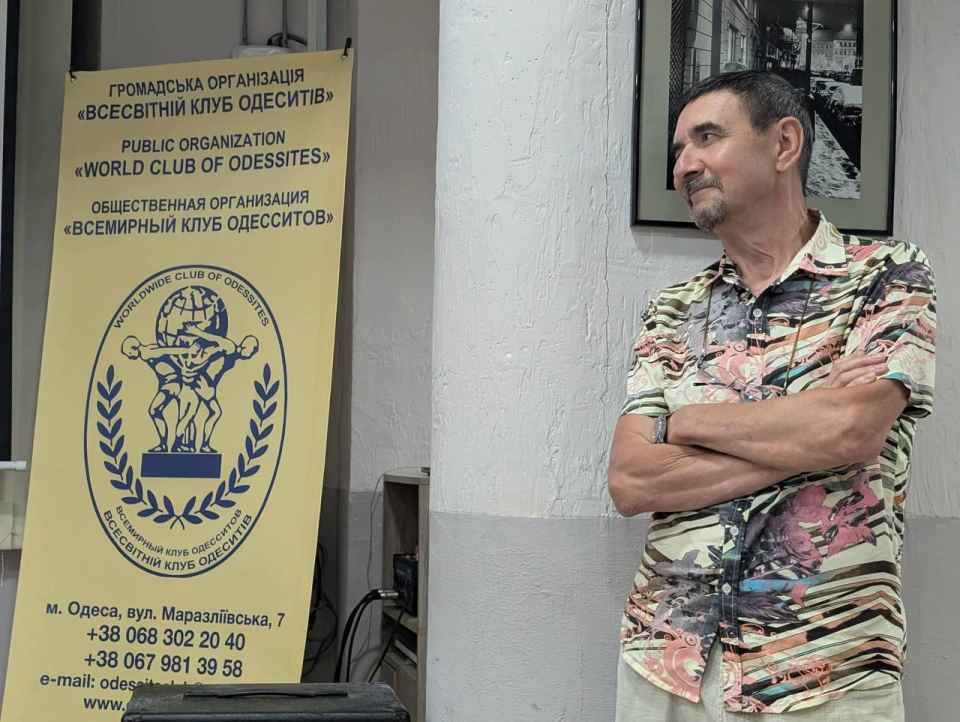
Alexander BIRSHTEIN, writer, member of the World Club of Odesites
The World Club of Odesites extends its sincere condolences to the family, friends, and colleagues of Yury Khashchevatsky — an outstanding documentary filmmaker, talented artist, courageous and principled person whose work received worldwide recognition.
May his memory be a blessing…